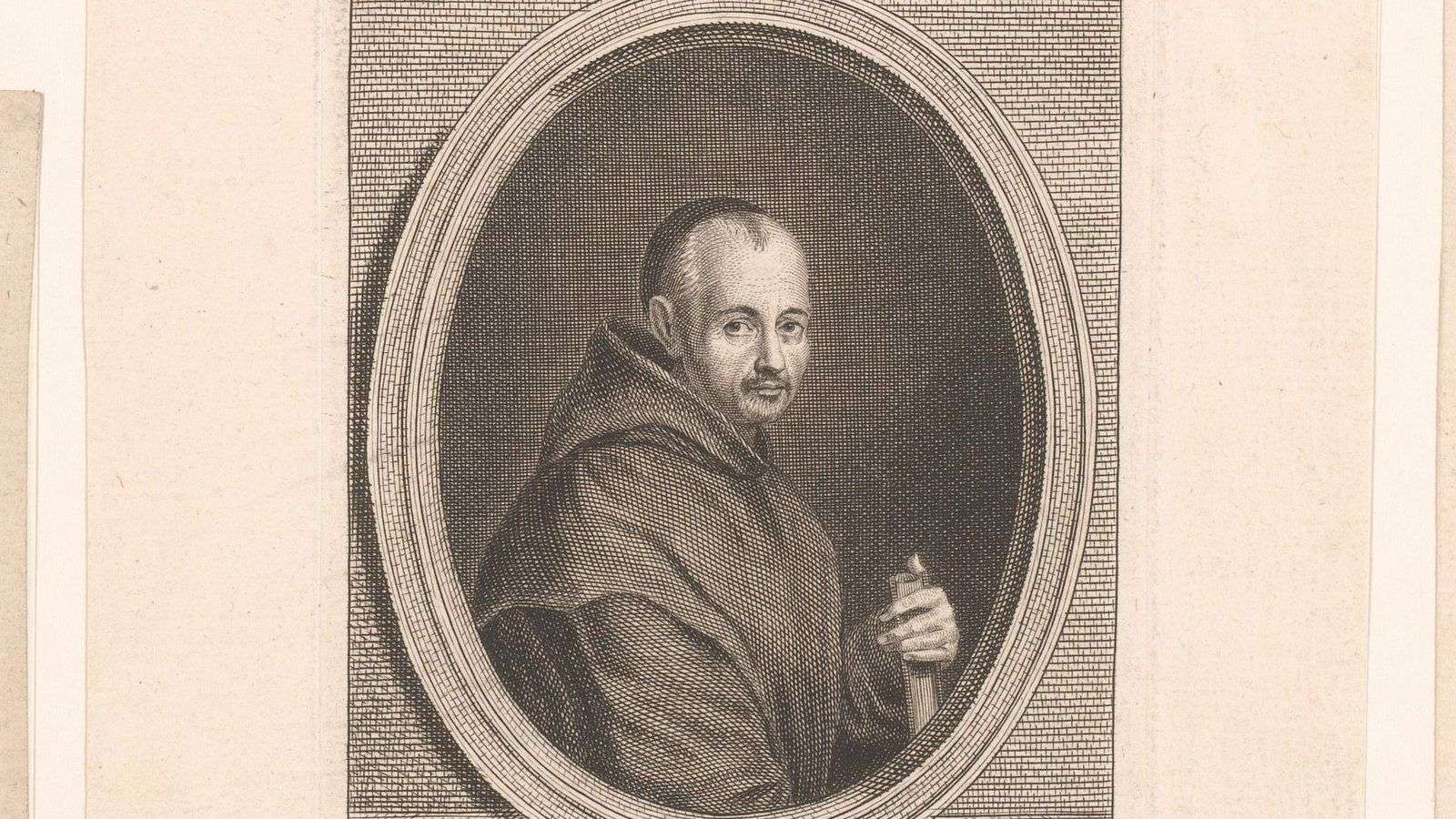
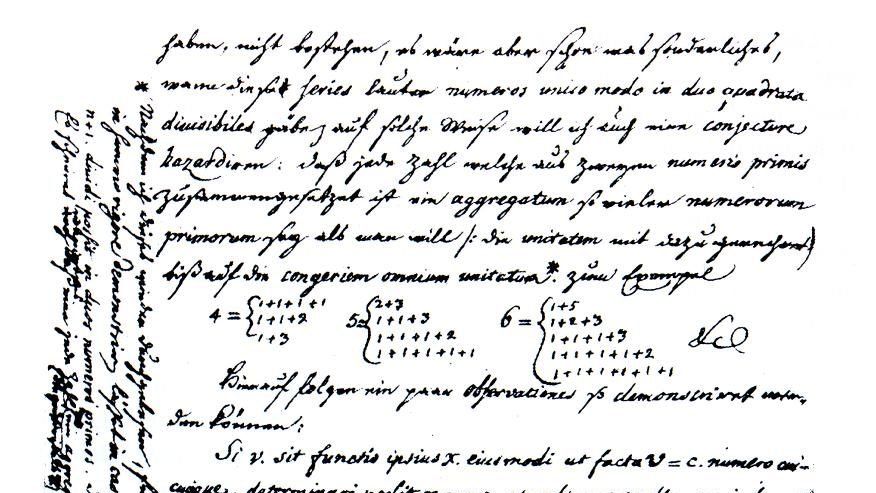
 Image: Christian Goldbach, letter of 7 June 1742 (public domain)
Goldbach's conjecture, checked to four quintillion
On 7 June 1742 Christian Goldbach, a Prussian mathematician living in Russia, wrote to Leonhard Euler in Berlin. In the margin of the letter he noted that every integer greater than 2 seemed to be a sum of three primes, counting 1 as a prime as was common then. Euler replied on 30 June that the statement was equivalent to a simpler one, that every even number is a sum of two primes, and that he held this to be a certain theorem although he could not prove it. In modern form, with 1 no longer prime: every even integer greater than 2 is the sum of two primes.
The examples are easy to make. 4 = 2 + 2, 6 = 3 + 3, 8 = 3 + 5, 10 = 3 + 7 = 5 + 5, and 100 = 3 + 97 = 11 + 89 = 17 + 83 = 29 + 71 = 41 + 59 = 47 + 53, six ways. The number of ways tends to grow with the number, unevenly, and the conjecture is that it never drops to zero.
Four quintillion
The conjecture has been checked by computer since the 1960s, and the current limit is 4 × 10¹⁸, four quintillion, reached on 4 April 2012 by Tomás Oliveira e Silva at the University of Aveiro with Siegfried Herzog and Silvio Pardi, in a computation that had run on and off since 2005. The method is a segmented sieve, as in the article on the sieve, applied cleverly: for each even n in a block, the program looks for the smallest prime p such that n - p is also prime, and it stops as soon as it finds one. The smallest p is almost always tiny, and the whole computation recorded which n needed the largest smallest prime. The record holder below 4 × 10¹⁸ is n = 3,325,581,707,333,960,528, whose smallest Goldbach partition uses p = 9781. No even number in that whole range needs a prime larger than 9781 for its first partition. The results and the method are on the project's page, which is the weekly resource of Unit 15 of the masterclass.
Why checking is not proving
The conjecture is a statement about infinitely many even numbers, and the computation covers finitely many. That is the whole objection, and it is not pedantry. Number theory has examples of statements true for enormous ranges and false beyond them. Gauss and others believed that li(x) is always greater than π(x), and it is, for every x anyone has computed; Littlewood proved in 1914 that the inequality reverses infinitely often, and the first reversal is now known to happen before 1.4 × 10³¹⁶, far beyond any table. The Pólya conjecture, that the integers up to x with an odd number of prime factors always outnumber those with an even number, holds up to 906,150,257 and fails there. A verification to 4 × 10¹⁸ is evidence of a kind, and it is also input to proofs that need the small cases handled, but it is not a proof, and Unit 8 of the masterclass opens with the distinction.
What has been proved
The proved results come from the Hardy-Littlewood circle method of 1923 and from sieves. In 1937 Ivan Vinogradov proved that every sufficiently large odd number is a sum of three primes, without saying how large; the bound was later made explicit but astronomically so, about 10^(1,300) at one stage. In 2013 Harald Helfgott closed the gap: every odd number greater than 5 is a sum of three primes. His proof lowered the "sufficiently large" to about 10²⁷ and David Platt's computation covered everything below that. The odd case, called the ternary or weak Goldbach conjecture, is a theorem.
The even case is harder because a sum of two primes has far less freedom than a sum of three, and the circle method loses control of the error. The closest result is Chen Jingrun's theorem of 1973: every sufficiently large even number is the sum of a prime and a number with at most two prime factors. For 98 that is 7 + 91 with 91 = 7 × 13, next to the true Goldbach pairs 19 + 79 and 31 + 67 and 37 + 61. Chen's proof is a sieve argument of great difficulty, and the obstacle to going from "at most two prime factors" to "one" is the parity problem of sieve theory, which Unit 15 of the masterclass explains: a sieve on its own cannot distinguish numbers with an odd number of prime factors from those with an even number.
Two further partial results are worth knowing. Almost all even numbers satisfy the conjecture, in the sense that the exceptions below x, if any, number at most x^(1-c) for some positive c; this is a theorem from the 1930s. And every even number is a sum of at most six primes, proved by Ramaré in 1995, improved to four by Helfgott's work since three primes handle the odd case and adding 3 handles the even case.
The expected number of ways
Hardy and Littlewood conjectured in 1923 a formula for the number of ways to write n as a sum of two primes. Up to a correction factor depending on the odd prime factors of n, it is about n / (ln n)², and the correction factor, a product over the primes dividing n, is why numbers with many small prime factors have more partitions. The formula matches the data well: Oliveira e Silva's page reports that up to 2⁴⁰ the prediction, in the refined form of Crandall and Pomerance, never deviates from the truth by more than 401,900, for counts in the millions. A proof of the formula would prove the conjecture with room to spare, and nobody can prove it.
The letter
The letter is preserved, and the conjecture is in the margin, next to a passage about sums of primes, with the words "Es scheint wenigstens, dass eine jede Zahl, die grösser ist als 2, ein aggregatum trium numerorum primorum sey" (it seems at least that every number greater than 2 is an aggregate of three primes). Goldbach was Euler's regular correspondent, the tutor of the young Tsar Peter II, and a competent mathematician without a great theorem of his own; the conjecture that carries his name is the one thing most people know about him, and it was Euler who gave it the form we use. It is 284 years old and it is the most famous unsolved problem that a child can understand.
Unit 8 of the masterclass, the last of the Foundation units, sets Goldbach's conjecture next to the twin prime conjecture, the Riemann hypothesis, and Fermat's Last Theorem, and explains for each what is proved, what is checked, and what the difference is; Unit 15 shows how far a sieve can carry the two-prime problem and where it stops.