 Image: Geek3, Wikimedia Commons (CC BY 3.0)
What the Riemann hypothesis actually says
In 1859 Bernhard Riemann, newly elected to the Berlin Academy, sent it an eight-page paper on the number of primes below a given magnitude. In it he made a remark, in passing, that a certain function very probably has all its zeros on a certain line, adding that he had put the question aside after a few fleeting attempts because it was not needed for what he was doing. The remark is the Riemann hypothesis. It is the one problem on both Hilbert's list of 1900 and the Clay Mathematics Institute's list of 2000, with a million-dollar prize, and it is the central open question about the prime numbers.
The function
The zeta function is the sum 1 + 1/2^s + 1/3^s + 1/4^s + ..., written ζ(s). For s = 2 it is Euler's famous π²/6; for s = 1 it is the harmonic series and diverges; for any s greater than 1 it converges. Euler noticed in 1737 that the sum equals a product over the primes: ζ(s) is the product, over all primes p, of 1/(1 - p^(-s)). Multiply the geometric series for each prime together and every integer appears exactly once, by unique factorization. That identity is how the primes enter. Everything about the sum is elementary; everything about the product is about primes; and the equation between them means that facts about one side are facts about the other.
Riemann's step was to allow s to be a complex number, s = σ + it, and to show that the function defined by the sum for σ greater than 1 extends to a function on the whole plane, with a single pole at s = 1 and a symmetry, the functional equation, relating its value at s to its value at 1 - s. Unit 13 of the masterclass builds the complex numbers needed from nothing and carries this out.
The zeros
Where is ζ(s) = 0? The functional equation forces zeros at the negative even integers -2, -4, -6, ..., called trivial. The product shows there are none with σ greater than 1, and the functional equation then rules out σ less than 0 apart from the trivial ones. All the other zeros lie in the strip 0 ≤ σ ≤ 1, and there are infinitely many of them. The first few are at approximately 1/2 + 14.135i, 1/2 + 21.022i, 1/2 + 25.011i, and 1/2 + 30.425i. Every one of them has real part exactly 1/2.
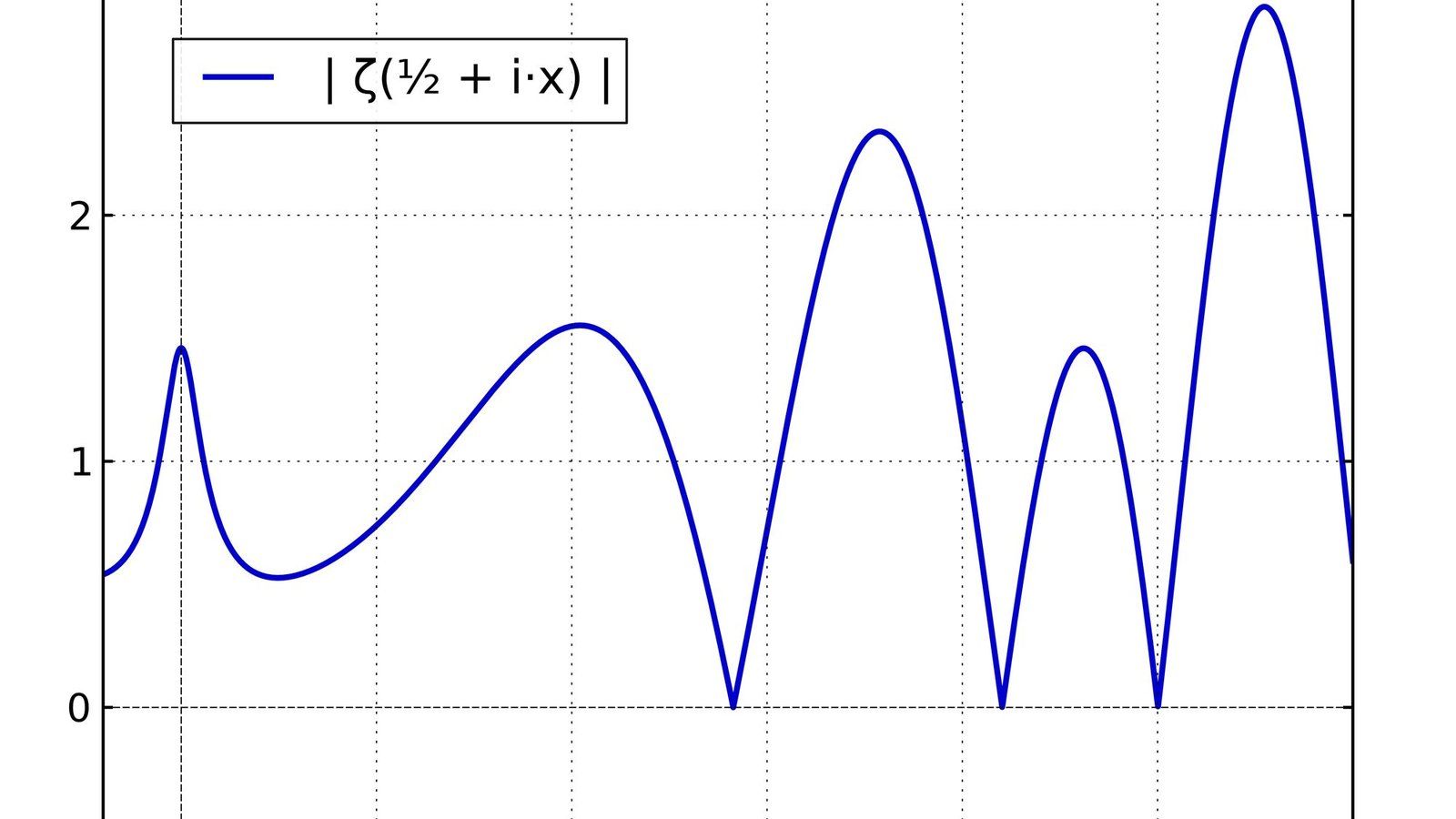
The Riemann hypothesis is the statement that every non-trivial zero has real part 1/2, that is, lies on the line σ = 1/2 through the middle of the strip, called the critical line. The cover image of this article shows the absolute value of ζ(1/2 + it) for t up to 30; the places where the curve touches zero are the first three zeros.
What that has to do with primes
Riemann's paper gives an exact formula for the number of primes below x in terms of the zeros. In the form Hans von Mangoldt proved in 1895, it says that a certain weighted count of primes up to x equals x minus a sum over the zeros ρ of x^ρ / ρ, minus a small correction. Each zero contributes a wave, whose size is x to the power of the real part of ρ and whose wavelength is set by the imaginary part. The main term x is the prime number theorem. The waves are the fluctuations of the primes around it, and their size is governed by how far right the zeros sit: a zero with real part σ gives a wave of size x^σ.
If all zeros have real part 1/2, every wave is of size √x, and the count of primes up to x fluctuates around its average by no more than about √x ln x. If even one zero had real part 0.6, there would be a wave of size x^0.6, and the primes would be less regular than that. So the hypothesis is a statement about the primes, and it is the sharpest one possible: the fluctuations of a random sequence with the same density would also be of size about √x, so the hypothesis says that the primes are as evenly distributed as a random sequence, and no more.
The elementary form
Here is the hypothesis without complex numbers. Let π(x) be the number of primes up to x and li(x) the logarithmic integral, the integral of 1/ln t from 2 to x, which is Gauss's estimate for π(x). Then the Riemann hypothesis is equivalent to the statement that
|π(x) - li(x)| is less than √x ln x for all x ≥ 3,
or, in the sharper form proved by Lowell Schoenfeld in 1976, less than √x ln x / (8π) for x ≥ 2657. Equivalence means both directions: if the inequality holds, every zero is on the line, and if every zero is on the line, the inequality holds. For x = 10⁶ the difference is 130 and the first bound, √x ln x, is 13,815; for x = 10⁹ the difference is 1,701 and the bound is 655,000. The hypothesis says that this never gets out of hand, and the data agree, but data up to any finite x prove nothing about the rest, exactly as with Goldbach's conjecture.
There are many other equivalent forms, some of which look like they belong in a different subject. Guy Robin showed in 1984 that the hypothesis is equivalent to the inequality σ(n) < e^γ n ln ln n for all n greater than 5040, where σ(n) is the sum of the divisors of n and γ is Euler's constant 0.5772. That is a statement about divisors, checkable for any single n, and it is in Unit 13 of the masterclass as a worked example.
What is known
Hardy proved in 1914 that infinitely many zeros lie on the critical line, and later work showed that at least 40 percent of them do, with the current proportion a little above that. Nobody has shown that all do, and nobody has shown that any lies off it. Computation has located the first 12,363,153,437,138 zeros, every one with imaginary part below 3 × 10¹², and every one on the line; this is the 2021 verification by David Platt and Tim Trudgian that the research spotlight of Unit 13 presents, carried out with interval arithmetic so that rounding errors cannot produce a false result. The zeros are not simply found and checked: the computation counts how many zeros there must be below a given height by an exact formula and then finds that many sign changes on the line, so none can be hiding elsewhere.
The hypothesis has also been proved in an analogous setting, for the zeta functions of curves over finite fields, by Weil in the 1940s and for higher dimensions by Deligne in 1974. Those proofs use geometry that has no counterpart over the integers, so far, and the question of whether there is a structure behind the zeros, a Hermitian operator whose eigenvalues they are, has been pursued since Hilbert and Pólya suggested it a century ago. The statistics of the zeros, studied by Montgomery and Odlyzko, match the statistics of eigenvalues of random matrices to many digits, which is evidence for the idea and not a proof.
Why it is worth a million dollars
Hundreds of theorems are proved "assuming the Riemann hypothesis", and more under its generalization to Dirichlet L-functions. A proof would convert them all into theorems. It would give the best possible error term in the prime number theorem and in Dirichlet's theorem on primes in progressions, would settle the running time of several algorithms, and would open the road to the deeper structure, if there is one. A disproof, a single zero off the line, would be more surprising and arguably more interesting, since it would show that the primes carry a signal nobody has predicted.
Unit 13 of the masterclass is a full unit on the zeta function: the complex toolkit built from scratch, the continuation, the functional equation stated, the first zeros computed, the explicit formula read aloud term by term, and the hypothesis in all three forms above. It is the first unit of the analytic tier, and it is where the prime number theorem of Unit 12 is finally explained.