Number Theory Masterclass 12-Week Program in Number Theory

Study the integers one unit per week, with every proof written out and the open problems that number theorists are working on today.

  • Certificate
  • Online
  • Join a community of 2500+

Theorem (Euler product). For every real number ,

(1)
Euler product formula Leonhard Euler, 1737 Every positive integer on the left, only the primes on the right. The two sides agree because each integer factors into primes in exactly one way. Taught in Unit 12, The Distribution of the Primes

Twelve weeks with the primes

The NT Masterclass takes you through number theory one unit at a time. You enrol, and from then on a new unit reaches you every week. Each unit is a chapter written for this program, with complete proofs, worked examples, and the published research of number theorists who are active today.

A quiz completes every unit and opens the next. At the end you sit a final exam and receive a certificate with a public verification page.

  • Structured. A fixed sequence of units that begins with proof and divisibility and ends at problems that are still open.
  • Demanding and fair. Theorems come with full proofs, and each proof is written out in steps you can check with pencil and paper.
  • Recognized. A certificate and a transcript, both with a verification ID that anyone can check online.
How the program works

Theorem (Fundamental theorem of arithmetic). Every integer can be written as a product of primes

with primes and exponents , and this product is unique.

Example. .

Fundamental theorem of arithmetic Euclid's lemma, Elements, Book VII, about 300 BC; first complete proof by Carl Friedrich Gauss, 1801 The reason the primes are the building blocks of the integers. Taught in Unit 3, Prime Numbers and Unique Factorization

Who is this program for?

For high school students, university students, and lifelong learners. You do not need any experience with proofs: Unit 1 gives every participant the same toolkit.

Theorem (Fermat's little theorem). If is a prime and is an integer, then

Example. .

Fermat's little theorem Pierre de Fermat, 1640; first published proof by Leonhard Euler, 1736 Olympiad solutions use it constantly, and with Euler's theorem it is what makes RSA encryption work. Taught in Unit 5, The Theorems of Fermat, Euler, and Wilson

High School Students

You like problems that have no formula to plug into. The masterclass gives you the theory behind olympiad number theory and prepares you for university applications and for competitions such as the International Mathematical Olympiad (IMO), the European Girls' Mathematical Olympiad (EGMO), and your national olympiad.

  • School algebra is enough
  • Certificate for applications
  • Proofs written out in full

University Students

A companion to your degree in mathematics, computer science, or physics. Use it to prepare for a number theory or cryptography course, a thesis, or competitions such as the Putnam and the International Mathematics Competition for University Students (IMC).

  • Complete proofs and worked examples
  • Current research papers
  • A base for a first project

Lifelong Learners

You have read about the Riemann hypothesis or Fermat's Last Theorem and want to understand the mathematics behind the headlines. Or you solve Project Euler problems and want the theory that makes your programs fast. The masterclass goes step by step, at your pace.

  • No deadlines, pause any time
  • Unit 1 sets out the toolkit
  • Read on screen or as PDF

Euclid's algorithm. Divide with remainder until the remainder is zero. The last nonzero remainder is the greatest common divisor:

Remark. Read from the bottom up, the same lines give Bézout's identity, the last line above.

Euclidean algorithm and Bézout's identity Euclid, Elements, Book VII, Propositions 1 and 2, about 300 BC Four divisions find the greatest common divisor of 252 and 198 and write it as a combination of the two numbers. Taught in Unit 2, Divisibility and the Euclidean Algorithm

How does it work?

From enrolment to certificate in six steps.

  1. Step 1: Enrol

    Create your account with your email address, choose your masterclass, and pay the Tuition Fee. Your program starts at once.

  2. Step 2: Receive your unit

    Unit 1 arrives immediately and every further unit on a Monday, as a web page and as a PDF to keep.

  3. Step 3: Study

    Work through the proofs and the worked examples, and answer the questions in the text as you go. A day later we send further reading, including research papers that are free to read.

  4. Step 4: Take a quiz for every unit

    Each unit has its own quiz: ten questions, open book, no time limit. You submit it before the next unit is sent to you.

  5. Step 5: Sit the final exam

    50 questions across the units of your masterclass in 60 minutes, open book. You pass with 70% and have up to 3 attempts.

  6. Step 6: Earn your certificate

    Certificate and transcript as PDF, each with a verification ID and a personal link you can share.

Topics

Sixteen units in three parts. The Foundation masterclass covers Units 1 to 8, Advanced continues to Unit 12, and Advanced + Analytic Number Theory adds Units 13 to 16.

Theorem (Prime number theorem). Let be the number of primes up to . Then

Remark. The logarithmic integral comes closer still: it misses the 78,498 primes below one million by 130.

Prime number theorem Guessed by Gauss and Legendre in the 1790s; proved by Jacques Hadamard and Charles de la Vallée Poussin, independently, 1896 Near a large number N about one integer in ln N is prime. The proof runs through the zeros of the zeta function. Stated in Unit 12, The Distribution of the Primes; proved through the zeta function in Unit 13, The Riemann Zeta Function
Papyrus fragment of Euclid's Elements found at Oxyrhynchus, 3rd to 4th century AD, with Book II, Proposition 5 and its diagram.
Papyrus of Euclid's Elements, P.Oxy. I 29

Units 1 to 8

The Integers

How a proof works, divisibility and the primes, arithmetic modulo , the theorems of Fermat and Euler, and whole-number solutions of equations, with a closing unit on the great open problems.

Wilson's theorem, Unit 5
The eight units
  1. Proof, Induction, and the IntegersThe unit opens with an homage to number theory and then builds the toolkit of the whole program: the notation for the integers, sums, floors, and binomial coefficients; what a proof and a counterexample are, shown by Euler's factor of the fifth Fermat number; direct proof, contrapositive, and contradiction, with the irrationality of the square root of 2; induction in its weak and strong forms and the well-ordering principle; the pigeonhole principle; and the digit count of the largest known prime as a first lesson in how fast numbers grow.
  2. Divisibility and the Euclidean AlgorithmDivision with remainder is the first theorem of number theory, and this unit shows how much follows from it: positional notation in any base, Euclid's algorithm for the greatest common divisor with Lamé's bound on its running time, Bézout's identity and the extended algorithm that finds its coefficients, and the complete solution of the linear Diophantine equation ax + by = c. The same algorithm computes the inverses that every public-key cryptosystem needs.
  3. Prime Numbers and Unique FactorizationEvery integer greater than 1 is a product of primes in exactly one way, and this unit proves it, from the smallest divisor of a number to Euclid's lemma. It shows how the sieve of Eratosthenes finds every prime below a bound, why Euclid's argument gives endlessly many primes without a formula for them, how the exponents of a factorization answer questions about divisors, square roots, and factorials, and why recognizing a prime is a far easier task than factoring a number.
  4. Congruences and Modular ArithmeticGauss's congruence notation turns questions about divisibility into arithmetic with finitely many residues. This unit builds that arithmetic, shows when a factor may be cancelled and which residues have an inverse, solves linear congruences and systems of them with the Chinese remainder theorem, computes large powers by repeated squaring, and explains the divisibility tests and the check digits of book numbers and bank accounts.
  5. The Theorems of Fermat, Euler, and WilsonFermat's little theorem with two proofs, Euler's totient function and Euler's theorem, the multiplicative order, and Wilson's theorem, which characterizes the primes by one congruence. The theorems are then put to work: the Fermat test and its refinement by Miller and Rabin tell composites from primes without factoring, and the RSA cryptosystem turns Euler's theorem into the lock behind the certificates of most secure connections on the internet.
  6. Arithmetic Functions and Perfect NumbersThe number of divisors of an integer, their sum, and Euler's totient can all be read off the factorization, because each of them is multiplicative. This unit proves that divisor sums preserve multiplicativity, introduces the Möbius function and the inversion formula that undoes a divisor sum, shows that the integers up to N have about ln N divisors on average, and proves the Euclid-Euler theorem that ties the even perfect numbers to the Mersenne primes. It ends with amicable numbers, aliquot sequences, and two questions open since antiquity.
  7. Diophantine EquationsAn equation becomes Diophantine when its solutions must be integers, and then even a simple one can take centuries to settle. This unit teaches the three classical methods: the parametrization of all solutions, shown on the Pythagorean triples and the rational points of the circle; Fermat's method of descent, with the full proof that x to the 4 plus y to the 4 equals z squared has no solution; and congruence obstructions such as the one that rules out y squared equals x cubed plus 7. It ends with Pell's equation, whose infinitely many solutions all grow out of the smallest one, and with a first look at the curves of degree three that current research is about.
  8. The Great Problems of Number TheoryThe closing unit of the Foundation masterclass presents the statements that nobody has proved and the one that was proved in 1995 after 358 years. It explains why a verification to four billion billion cases settles nothing, states Goldbach's conjecture, the twin prime conjecture, the prime number theorem, and the Riemann hypothesis in a form that needs no complex numbers, proves Euler's product formula and the divergence of the sum of the reciprocals of the primes from unique factorization, and tells the story of Fermat's Last Theorem from the margin note to Wiles. It ends with Landau's problems, the Collatz problem, number theory in daily use, and the roads that lead on from here.
Page 133 of Gauss's Disquisitiones Arithmeticae, 1801, with his table of cases for quadratic reciprocity.
Disquisitiones Arithmeticae, 1801, page 133

Units 9 to 12

Residues, Squares, and Primes

Primitive roots, Gauss's law of quadratic reciprocity, which numbers are sums of two or four squares, and how the primes thin out along the number line.

Lagrange's four-square theorem, Unit 11
The four units
  1. Primitive Roots and the Structure of ResiduesModulo every prime there is a residue whose powers run through all the others, and this unit proves it by counting the residues of each order, after Lagrange's theorem on polynomial congruences has limited how many roots a congruence can have. It works out which moduli have such a primitive root, turns multiplication into addition with Gauss's indices, explains why the digits of 1/7 repeat every six places, and ends with the Diffie-Hellman key exchange, the discrete logarithm problem behind it, and the attack of 2015 that broke it for shared 512-bit primes.
  2. Quadratic Residues and Quadratic ReciprocityHalf of the non-zero residues modulo an odd prime are squares, and this unit shows how to tell which half. Euler's criterion decides it with one exponentiation, the two supplements settle the cases of minus 1 and 2, and the law of quadratic reciprocity ties the question for p and q together, with a complete proof by Eisenstein's count of lattice points. The Jacobi symbol turns the law into an algorithm that needs no factoring, and the closing section looks at the random-looking sequence of Legendre symbols, the Pólya-Vinogradov inequality, and the least non-residue.
  3. Sums of Squares and Quadratic FormsWhich integers are sums of two squares, of three, of four? This unit proves Fermat's theorem that every prime of the form 4k + 1 is a sum of two squares, finds the two squares with Euclid's algorithm, counts the representations with Jacobi's formula, and proves Lagrange's four-square theorem by descent. It then introduces the binary quadratic forms behind these results, reduces them, counts their classes, and shows how the two classes of discriminant minus 20 explain the two factorizations of 6, before the lattice picture leads to Gauss's circle problem and to the sphere packing in eight dimensions.
  4. The Distribution of the PrimesThis unit measures how the primes thin out. It compares the counts of primes up to ten billion with the guesses of Gauss and Legendre, defines the O notation, and proves with one binomial coefficient and Legendre's formula that pi(x) lies between two fixed multiples of x/ln x and that a prime always lies between n and 2n. It introduces the Chebyshev functions, proves the first of Mertens' theorems on sums over primes, shows what a random model of the primes predicts and where arithmetic corrects it, and ends with two races: the primes 4k + 3 against the primes 4k + 1, and pi(x) against li(x), where the leader changes only beyond 10^316.
Bernhard Riemann, whose 1859 paper on the number of primes below a given size introduced the Riemann hypothesis.
Bernhard Riemann, photographic portrait

Units 13 to 16

Analytic Number Theory

The Riemann zeta function and its zeros, Dirichlet's theorem on primes in arithmetic progressions, the sieves of Brun and Selberg, and the bounded gaps between primes proved since 2013.

Bounded gaps between primes, Unit 16
The four units
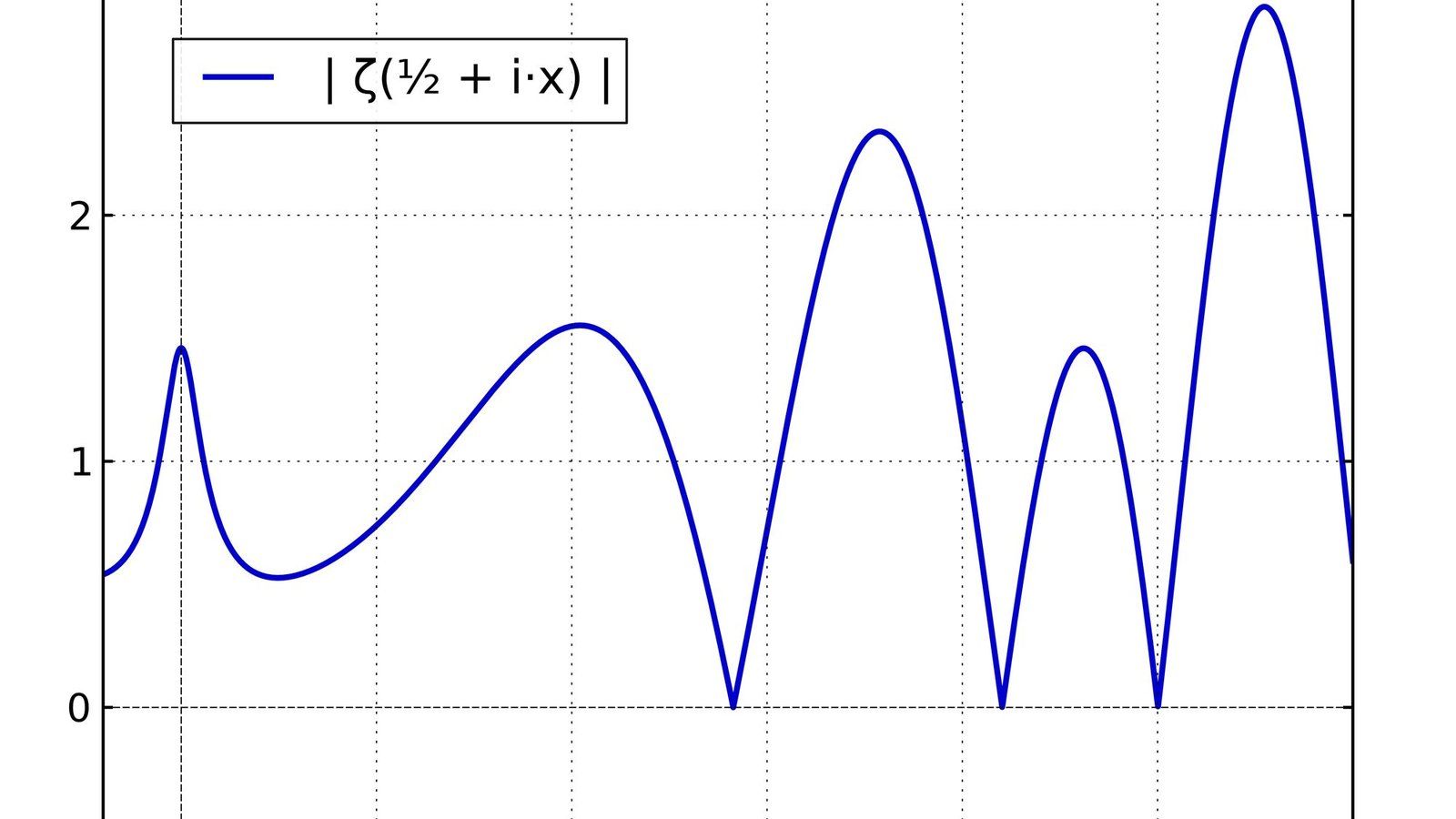
  1. The Riemann Zeta FunctionThe first unit of the analytic masterclass builds the complex numbers from scratch and follows Riemann's paper of 1859: the zeta function and its Euler product for complex s, the continuation past s = 1 by partial summation and the pole there, the functional equation with the trivial zeros and the values at 0 and at minus 1, the critical strip and the first zeros on the critical line, and the Riemann hypothesis. The explicit formula then writes the staircase of the prime powers as the line x minus one wave for every pair of zeros, the prime number theorem becomes the statement that no zero lies on the line of real part 1, and the unit ends with what is known: the proportion of zeros proved to lie on the critical line, the twelve trillion zeros verified by computer, the pair correlation of Montgomery and Dyson, and Robin's criterion.
  2. Primes in Arithmetic ProgressionsEuclid's trick proves that infinitely many primes end in 1 or 9 but cannot reach the primes ending in 3 or 7. Dirichlet's theorem of 1837 reaches every admissible progression, and this unit proves it in full: the characters of the residues modulo q and their orthogonality, the L-functions with their Euler products, and the key fact that no L-function vanishes at s = 1. The closing sections look at how evenly the primes are shared among the residue classes, at Chebyshev's bias, at Dirichlet's class number formula, and at the Green-Tao theorem on arithmetic progressions made of primes.
  3. Sieve MethodsA sieve counts the members of a set that have no small prime factor, and the twentieth century turned the sieve of Eratosthenes into one of the two great tools for questions about primes. This unit derives Legendre's exact formula and shows why it is useless, follows Brun to his theorem that the reciprocals of the twin primes have a finite sum, derives Selberg's optimal weights and the bounds they give, states the Bombieri-Vinogradov theorem that feeds every modern sieve, and explains the parity problem, the barrier at which Chen's theorem stops and which Friedlander and Iwaniec crossed in 1998.
  4. Gaps Between PrimesThe closing unit of the masterclass studies the distances between consecutive primes. It derives their average ln p from the prime number theorem, reads the tables of record gaps against Cramér's conjecture, builds long runs of composite numbers and explains why they stay below the average, and states the theorems of Westzynthius, Rankin, and the two proofs of 2014 on large gaps. It then explains the method of Goldston, Pintz, and Yıldırım, admissible tuples, and the level of distribution, and tells how Zhang's 70 million became Maynard's 600 and the Polymath bound 246 within a year, and why the twin prime conjecture is still out of reach.

Full curriculum

Tuition Fee

Choose the masterclass that fits you. One Tuition Fee, paid once, covers all units, quizzes, the final exam, and your certificate.

Theorem (Law of quadratic reciprocity). For distinct odd primes and ,

Law of quadratic reciprocity Carl Friedrich Gauss, first proof 1796, published in the Disquisitiones Arithmeticae, 1801 It ties the question whether is a square modulo to the reverse question. Gauss called it the fundamental theorem and found eight proofs. Proved in full in Unit 10, Quadratic Residues and Quadratic Reciprocity, part of Advanced
8 weeks

Foundation

The fundamentals of number theory: proof, divisibility, primes, congruences, Fermat and Euler, and Diophantine equations.

Tuition Fee$35$39
Enrol in Foundation
  • 8 weekly units as web page and PDF
  • Quiz and further reading for every unit
  • Final exam, certificate, and transcript
Topics in this program
  1. 01
    Proof, Induction, and the Integers
  2. 02
    Divisibility and the Euclidean Algorithm
  3. 03
    Prime Numbers and Unique Factorization
  4. 04
    Congruences and Modular Arithmetic
  5. 05
    The Theorems of Fermat, Euler, and Wilson
  6. 06
    Arithmetic Functions and Perfect Numbers
  7. 07
    Diophantine Equations
  8. 08
    The Great Problems of Number Theory
  9. 09
    Primitive Roots and the Structure of Residues
  10. 10
    Quadratic Residues and Quadratic Reciprocity
  11. 11
    Sums of Squares and Quadratic Forms
  12. 12
    The Distribution of the Primes
  13. 13
    AnalyticThe Riemann Zeta Function
  14. 14
    AnalyticPrimes in Arithmetic Progressions
  15. 15
    AnalyticSieve Methods
  16. 16
    AnalyticGaps Between Primes
16 weeks

Advanced + Analytic Number Theory

The full program plus four units on analytic number theory: the zeta function, Dirichlet's theorem, sieves, and prime gaps.

Tuition Fee$85$119
Enrol in Advanced + Analytic Number Theory
  • 16 weekly units as web page and PDF
  • Quiz and further reading for every unit
  • Final exam, certificate, and transcript
Topics in this program
  1. 01
    Proof, Induction, and the Integers
  2. 02
    Divisibility and the Euclidean Algorithm
  3. 03
    Prime Numbers and Unique Factorization
  4. 04
    Congruences and Modular Arithmetic
  5. 05
    The Theorems of Fermat, Euler, and Wilson
  6. 06
    Arithmetic Functions and Perfect Numbers
  7. 07
    Diophantine Equations
  8. 08
    The Great Problems of Number Theory
  9. 09
    Primitive Roots and the Structure of Residues
  10. 10
    Quadratic Residues and Quadratic Reciprocity
  11. 11
    Sums of Squares and Quadratic Forms
  12. 12
    The Distribution of the Primes
  13. 13
    AnalyticThe Riemann Zeta Function
  14. 14
    AnalyticPrimes in Arithmetic Progressions
  15. 15
    AnalyticSieve Methods
  16. 16
    AnalyticGaps Between Primes

The Tuition Fee is paid once, by card through Stripe, and includes applicable taxes. It is set in US dollars, converted into your currency by your bank, and there are no further costs. Financial Aid

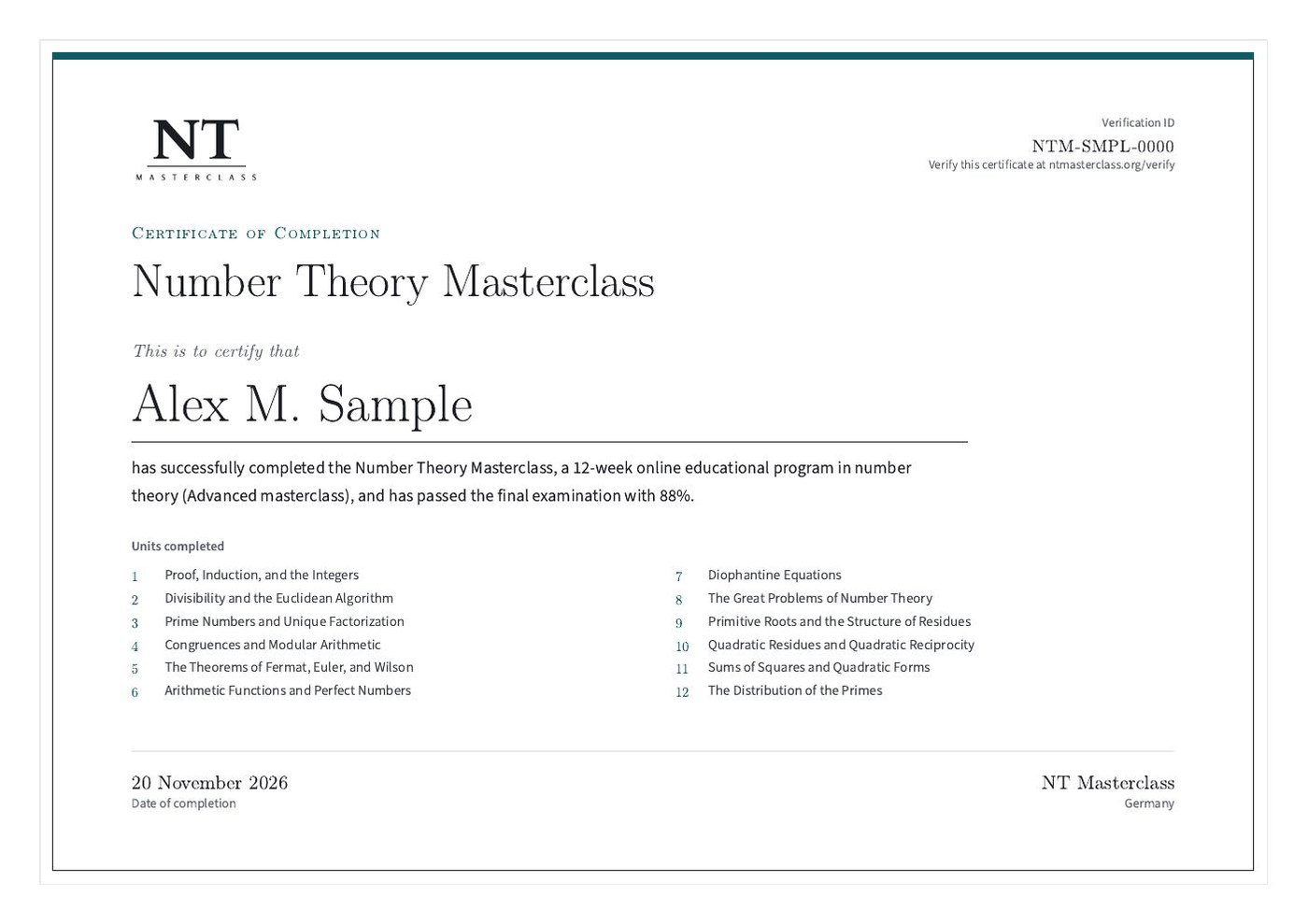
Sample certificate of completion of the Number Theory Masterclass
Certificate of completion Sample, issued as PDF The transcript that comes with it lists your score in every unit quiz and in the final exam.

Your certificate

Participants who pass the final exam receive an official certificate of completion. It states your name, the masterclass, its duration, and the units you completed.

  • Certificate and transcript. The transcript lists your score in every unit quiz and in the final exam.
  • Verifiable. Both documents carry a verification ID that can be checked on this website.
  • Shareable. Your personal verification link shows your result to universities, scholarship committees, and employers.
First page of Unit 3: Prime Numbers and Unique Factorization
Unit 3, first page Prime Numbers and Unique Factorization, 16 pages Typeset as participants receive it, with every proof written out.

Sample unit

Read one complete unit before you enrol, exactly as participants receive it: the full text with its proofs, worked examples, and research spotlight.

Unit 3, 16 pages

Prime Numbers and Unique Factorization

Every integer greater than 1 is a product of primes in exactly one way, and this unit proves it, from the smallest divisor of a number to Euclid's lemma. It shows how the sieve of Eratosthenes finds every prime below a bound, why Euclid's argument gives endlessly many primes without a formula for them, how the exponents of a factorization answer questions about divisors, square roots, and factorials, and why recognizing a prime is a far easier task than factoring a number.

By the end of the unit you can answer

  1. Why does every integer greater than 1 have at least one prime factor, and why does a composite number have one at most equal to its square root?
  2. How did Euclid prove that there are infinitely many primes, and why does his proof give no formula for them?
  3. Why can 360 be written as a product of primes in only one way, apart from the order of the factors?
  4. In the numbers 1, 5, 9, 13, 17, and so on, why does 441 factor in two different ways, and what does that tell me about the ordinary integers?
  5. How does the sieve of Eratosthenes find every prime below 100, and why can it stop crossing out after 7?

Academic community

Masterclass participants come from all over the world, and when you complete the program you stay part of a network that keeps you close to mathematics.

Mathematics academics in our community
2500+
Countries represented
90+
Schools and universities represented
750+

Conjecture (Goldbach). Every even integer greater than 2 is the sum of two primes.

Example. The number 100 is such a sum in six ways:

Goldbach's conjecture open problem From the letters of Christian Goldbach and Leonhard Euler, 1742 Computers have checked it up to , and nobody has proved it. Discussed in Unit 8, The Great Problems of Number Theory

NT-Connect

Our alumni program introduces former participants to one another across countries: for study advice, exchange about university applications, and shared projects.

Opportunities

Past participants hear from us about scholarships, competitions, summer schools, and other academic opportunities in mathematics.

A place in mathematics

The program shows you how research in number theory is done and where it happens, so that your next step at school, at university, or beyond is an informed one.

The academic community

Frequently asked questions

Who is this program for?

For high school students, university students, and lifelong learners. High school students use it to learn the number theory behind olympiad problems properly and to prepare for university applications. University students in mathematics, computer science, or physics take it next to their degree, before a number theory or cryptography module or a first project. Lifelong learners, among them many who solve Project Euler problems or have read about the Riemann hypothesis, use it to get the mathematics behind the headlines. The Foundation masterclass suits a first contact with the subject; the Advanced masterclass goes on to primitive roots, quadratic reciprocity, sums of squares, and the distribution of the primes.

What do I need to know before I start?

School algebra is enough: powers, fractions, simple equations, and a little work with inequalities. You do not need any experience with proofs. Unit 1 teaches induction, proof by contradiction, and the well-ordering principle, and every later unit uses them. There is no calculus in the first eight units; Unit 12 uses a simple integral inside a Proof box, with every step explained in words, and Unit 13 introduces complex numbers from scratch before it needs them.

How much time do I need each week, and are there live sessions?

Most participants spend three to five hours a week: two or three hours on the unit, under an hour on the open-book quiz, and the rest on the further reading if they want it. A unit with long proofs, such as the one on quadratic reciprocity, takes longer if you work through every proof with pencil and paper, which we recommend. The program is fully online and has no live sessions, so it works in every time zone and next to school, university, or work. You receive the units by email and read them on the website or as PDF. Quizzes and the final exam are taken on the website.

Can I finish the program in less than 12 weeks?

Yes. A new unit is scheduled for every Monday, but once you have submitted the quiz of a unit you can ask for the next one ahead of schedule, from your dashboard or from the email we send you. The earliest moment is 24 hours after the previous unit was sent. We recommend the weekly rhythm, because proofs need time to settle, but the pace is your decision.

What happens if I fall behind or have to pause?

Nothing is lost. The next unit is only sent once you have submitted the quiz of the current one, so the program waits for you. You can pause for a week or for a term and continue at any time. There is no penalty and no deadline.

How does the final exam work?

After the last unit you sit the final exam online: 50 multiple-choice questions across all units of your masterclass, drawn individually for each participant, with a time limit of 60 minutes. It is open book. You pass with 70% correct answers. If you do not pass, you can try again after 3 days with new questions, up to 3 attempts in total.

All questions

Stay up to date

New program dates, offers, and the occasional article about primes and the problems they pose. You can unsubscribe at any time.

From Euclid's proof: the primes 59 and 509 are missing from the list 2, 3, 5, 7, 11, 13.

Begin your 12 weeks with the primes