
Famous numbers
One number or one pattern per article: 1729 and Hardy's taxi, the six digits of 1/7, Euler's prime-producing polynomial, and the diagonals of the Ulam spiral.
Articles

Ulam's spiral and the diagonals of primes
Write the integers in a square spiral, mark the primes, and diagonal lines appear. Stanislaw Ulam noticed it while doodling through a dull talk in 1963. The lines are real, they are quadratic polynomials, and whether they go on for ever is an open question.
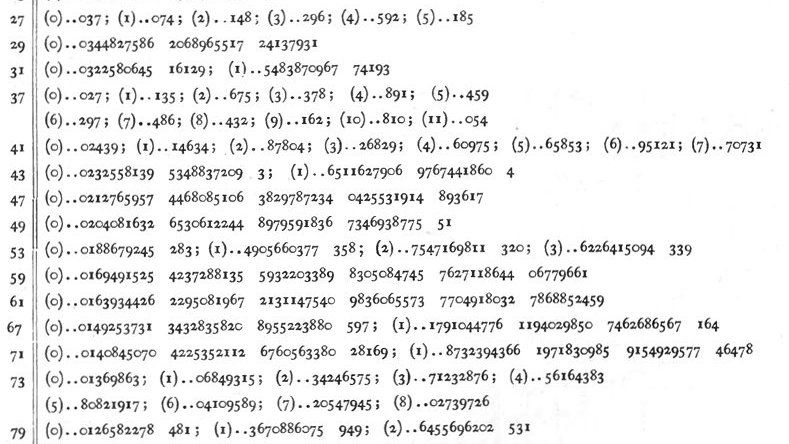
Why the digits of 1/7 repeat every six places
1/7 = 0.142857142857... and the block of six never changes. 1/13 repeats every six places too, 1/17 every sixteen, and 1/3 every one. The period is the order of 10 modulo the denominator, and the question of which primes get the longest possible period is still open.
1729, the number on Hardy's taxi
Hardy called the number of his taxi dull. Ramanujan, from his hospital bed, said it was the smallest number that is a sum of two cubes in two ways. Here is why that is true, what the taxicab numbers are, and how far the search has gone since 1919.
In the masterclass
The Theorems of Fermat, Euler, and Wilson
Three classical theorems about powers modulo a prime, and the cryptography built on them
Arithmetic Functions and Perfect Numbers
Counting and adding divisors, multiplicative functions, Möbius inversion, and the perfect numbers
Primitive Roots and the Structure of Residues
The multiplicative group modulo n, its generators, indices, and the Diffie-Hellman key exchange