
Cryptography and the integers
The arithmetic behind secure connections: Fermat and Euler in RSA, primitive roots in Diffie-Hellman, and primality tests, all worked with real numbers.
Articles
What Diffie-Hellman has to do with primitive roots
Two people who have never met agree on a secret number over a line that everyone can listen to. The trick, from 1976, is a primitive root modulo a prime and the fact that powers are easy to compute and hard to undo. Here it is with p = 23, and the 2015 attack that broke it for a large part of the internet.
Is this number prime? From Fermat's test to Miller-Rabin
Trial division decides whether a number is prime in a time that grows with its square root, hopeless at 300 digits. A test built on Fermat's little theorem does it in milliseconds, with a catch, and a repaired version runs inside every cryptographic library in use today.
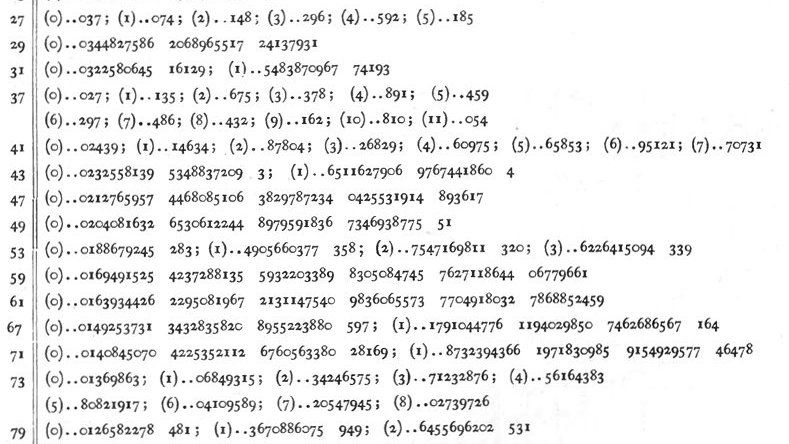
Why the digits of 1/7 repeat every six places
1/7 = 0.142857142857... and the block of six never changes. 1/13 repeats every six places too, 1/17 every sixteen, and 1/3 every one. The period is the order of 10 modulo the denominator, and the question of which primes get the longest possible period is still open.

How RSA encryption works, with the numbers
Two primes, one multiplication, and a theorem Euler proved in 1736: that is RSA. Here is the whole system worked through with p = 61 and q = 53, small enough to check by hand, and an explanation of why a 600-digit version keeps the web safe.
In the masterclass
Congruences and Modular Arithmetic
Arithmetic on a clock: residues, inverses, linear congruences, and the Chinese remainder theorem
The Theorems of Fermat, Euler, and Wilson
Three classical theorems about powers modulo a prime, and the cryptography built on them
Primitive Roots and the Structure of Residues
The multiplicative group modulo n, its generators, indices, and the Diffie-Hellman key exchange